
Behind the Clues: from Research Trip to Published Hunt
Last time I wrote about what happens on a research trip – the paper maps, the camera roll, the voice notes left outside war memorials. If you missed it, either go back and have a read or the short version is: we walk around a town for several hours looking at things very closely while other people wonder what on earth we're doing!
That's only half the story. Here's what happens next.
Editing the photo research down
All the photos get uploaded and the process begins. First pass is ‘definitely a clue, already got some semblance of an idea’. Sometimes this is just something cool, sometimes it’s something that just has to be in there – like you couldn’t do a hunt around Monument in London without including the monument itself! After the first pass it’s figuring out what will also work making sure it’s not too many of the same thing, e.g. plaques, and that there’s a good geographical spread. Keep going until we get to around 30. This is also a good time to spot any patterns or repeating information, e.g. Stratford-upon-Avon and the many gifted lampposts.
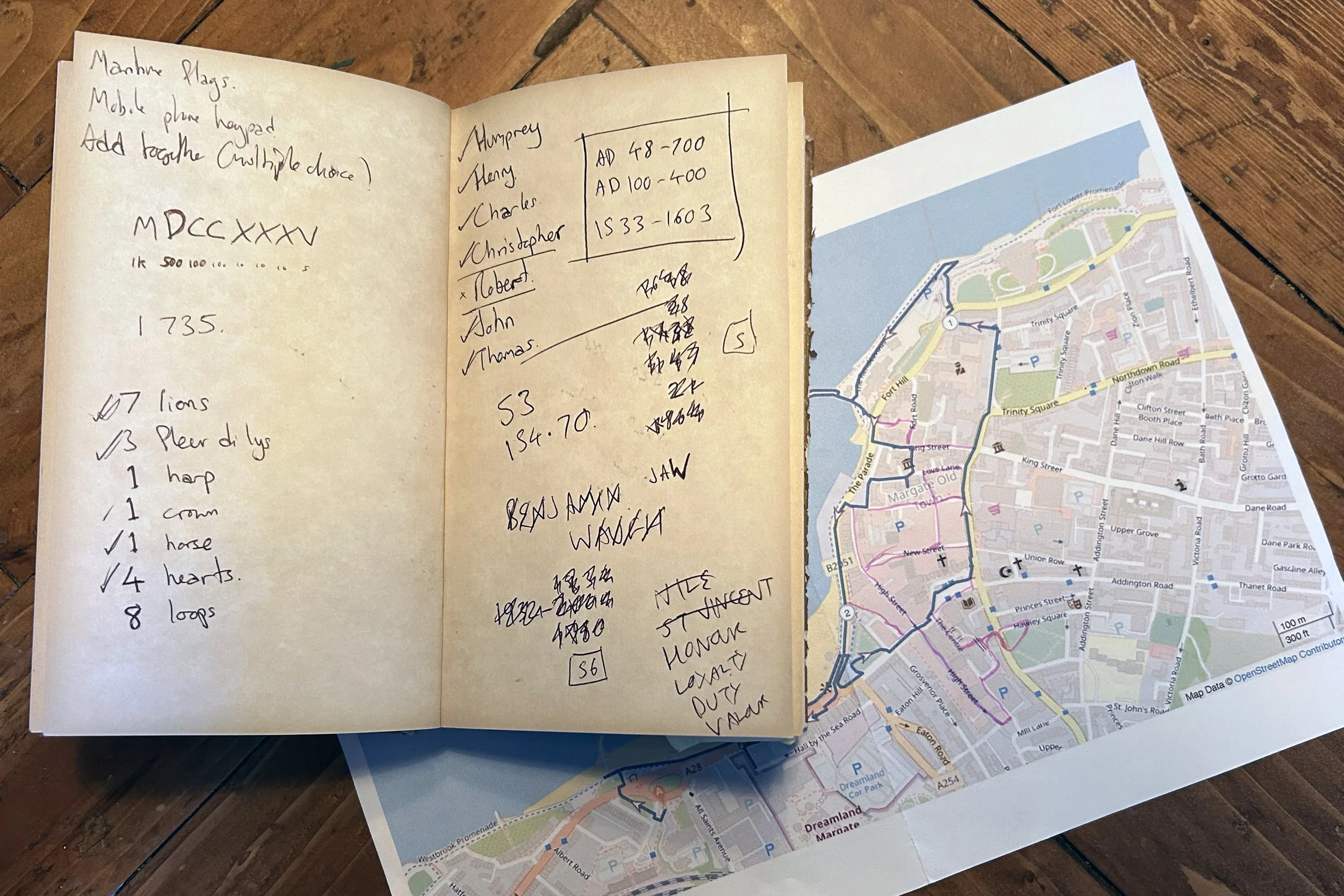
More workings of a mad man?! Perhaps…
Every clue needs a definitive answer. That sounds obvious until you're staring at something fascinating – a carving, an inscription, a detail that's been there for centuries – and realising there's no way to turn it into a question with one unambiguous answer. For example the detail below from a bench in Whitstable. Some might call it a shell, others a seashell, others a clam – none would be wrong but we need to make sure everyone has the same answer.
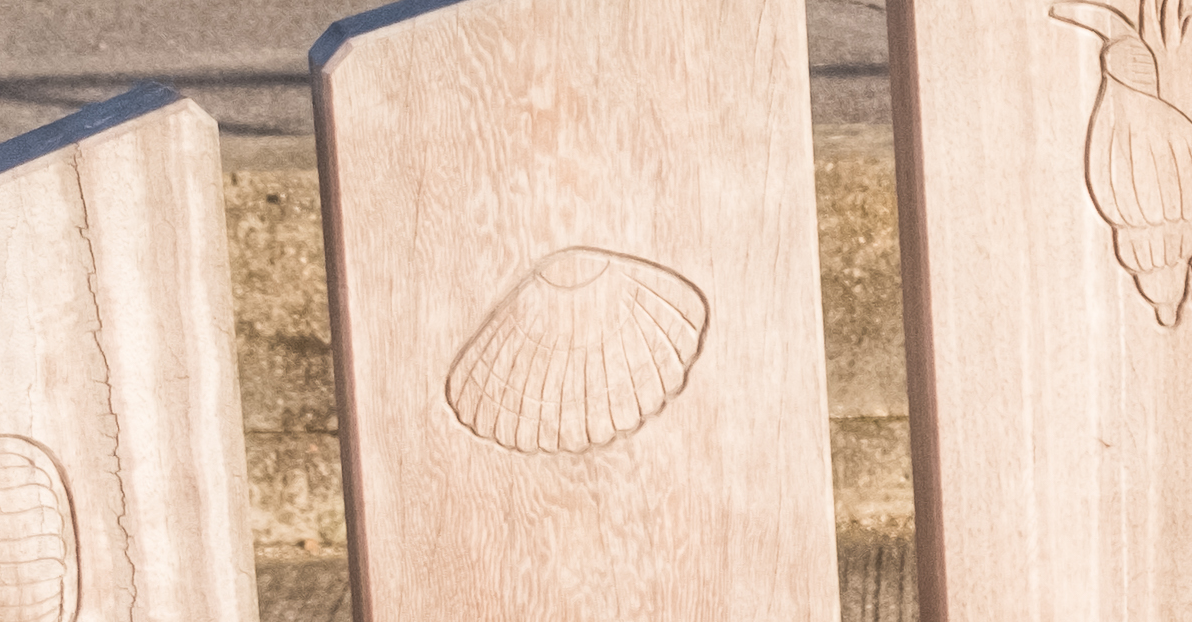
What would you call this?
Writing the clues
The ones that make it through have to do several things at once. They need to require players to physically go somewhere – ideally no clue in an X Hunts booklet is solveable from the sofa. They need a specific, confirmable answer. And ideally they need to feel satisfying when you crack them — the small jolt of "yes, got it" that makes the whole thing worthwhile.
Sometimes a clue arrives fully formed. The Tower Bridge hunt has a clue involving a horse statue and a code – which we couldn't resist calling Horse Code instead. That was a no brainer. Others take considerably longer.
The mix of clue types matters too. Purely observational clues — find this detail, note this fact — are quick and satisfying but can feel repetitive if you string too many together. Word puzzles, navigation clues, and cipher elements all add variety and change the pace, but take a bit longer so we don’t want them bunched together either. We try and get that balance right across thirty clues.
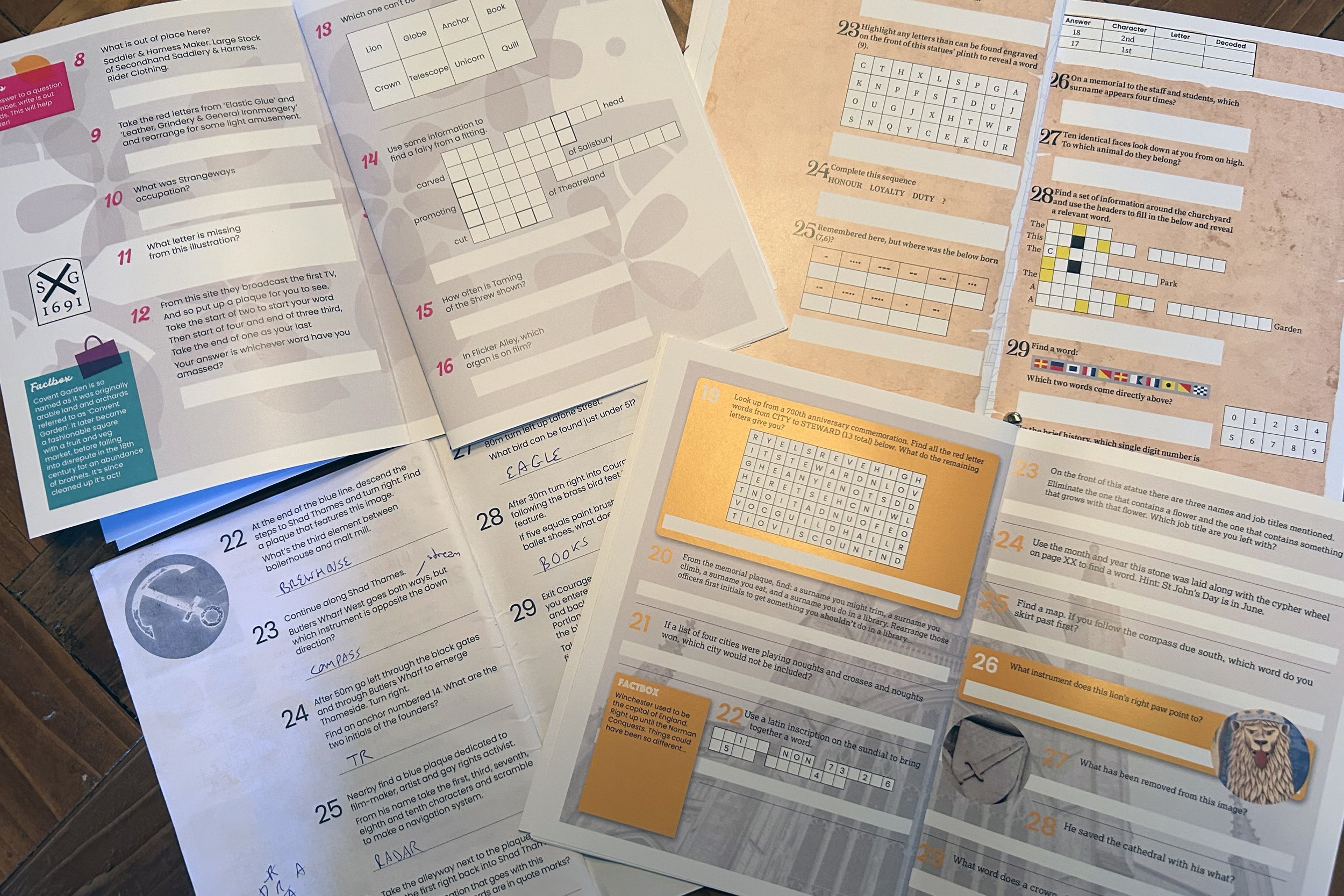
Some early interior ideas, including the non-designed version before any decisions were made (bottom left).
Deciding the vibe
Before a single clue is designed, we have to decide what a hunt feels like.
Every X Hunts hunt belongs to one of four design styles – Metropolitan, Heritage, Historic, and our forthcoming Seaside style. Same house colour palette across all four, but used completely differently. Different typefaces, different graphic approaches, different energy on the page.
Metropolitan is for urban, sophisticated locations – Covent Garden and Marylebone, where the streets have a certain polish and the history is layered underneath a very modern surface. Heritage is for the towns that feel like they've barely changed – Rye and Tewkesbury, where the medieval bones of the place are the whole point. Historic covers the grand, weighty locations – Gloucester, Warwick, Worcester – where the history is serious and the architecture announces itself. And Seaside, which we're developing now for Whitstable and beyond, needs its own distinct character entirely to reflect the great British seaside.
We want players to be immersed, so getting the theme wrong might make the hunt feel slightly off even if players couldn't tell you why. A Rye hunt that felt Metropolitan would jar. A Marylebone hunt that felt Heritage would be odd. The design has to match the place.
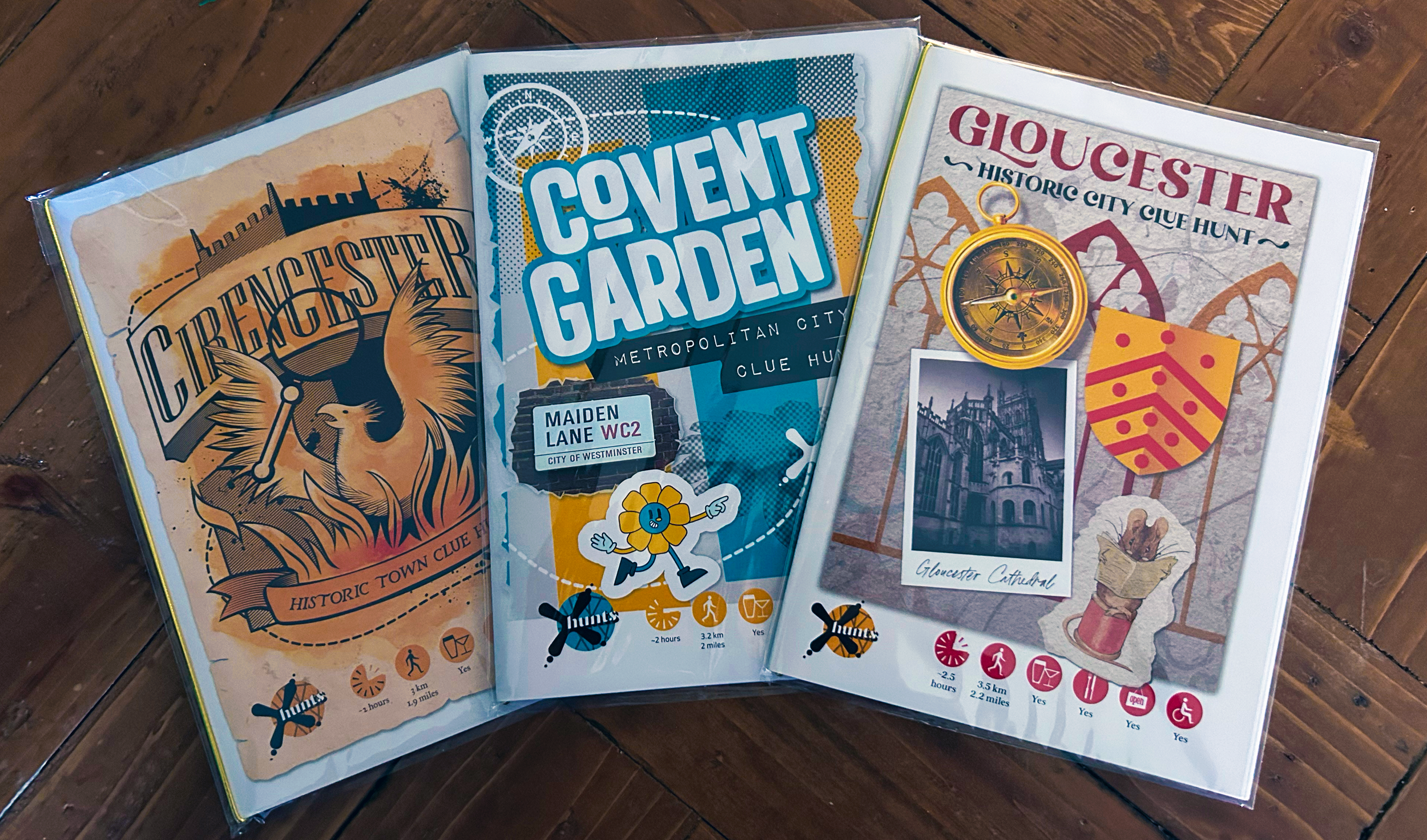
Heritage, Metropolitan and Heritage, in that order. All use X Hunts yellow, but in different ways.
Designing the booklet
For this section we have to go back a couple of years when we decided to take on this venture, just after we got (business) gazumped (a story for another post for which I’ll need alcohol).
We decided before we published any we wanted to write 20. Not sure where that number came from but it had to be 20! Time to experiment, mess up, find a style, and get into a groove. Then we could go back and refine, rewrite and work out what we were happy with and what we wanted to put out. Of that initial 20, 13 are now published (none of which as they were when originally written) and the very first place we visited is currently in the overhaul stage getting ready to be published… watch this space!
After the 20, then we started to think about how the finished product might look, and because we felt they couldn’t all look the same, we decided on the themes mentioned above.
Then we started tackling them one at a time. We noticed that several of our locations had a castle or cathedral so we set out to complete the ‘castles and cathedrals collection’, the first seven hunts.
The first in each theme are the hardest and take a lot of trial and error but once you have the style nailed down it’s a lot easier. Not necessarily quicker, there’s still a lot to design, but easier!
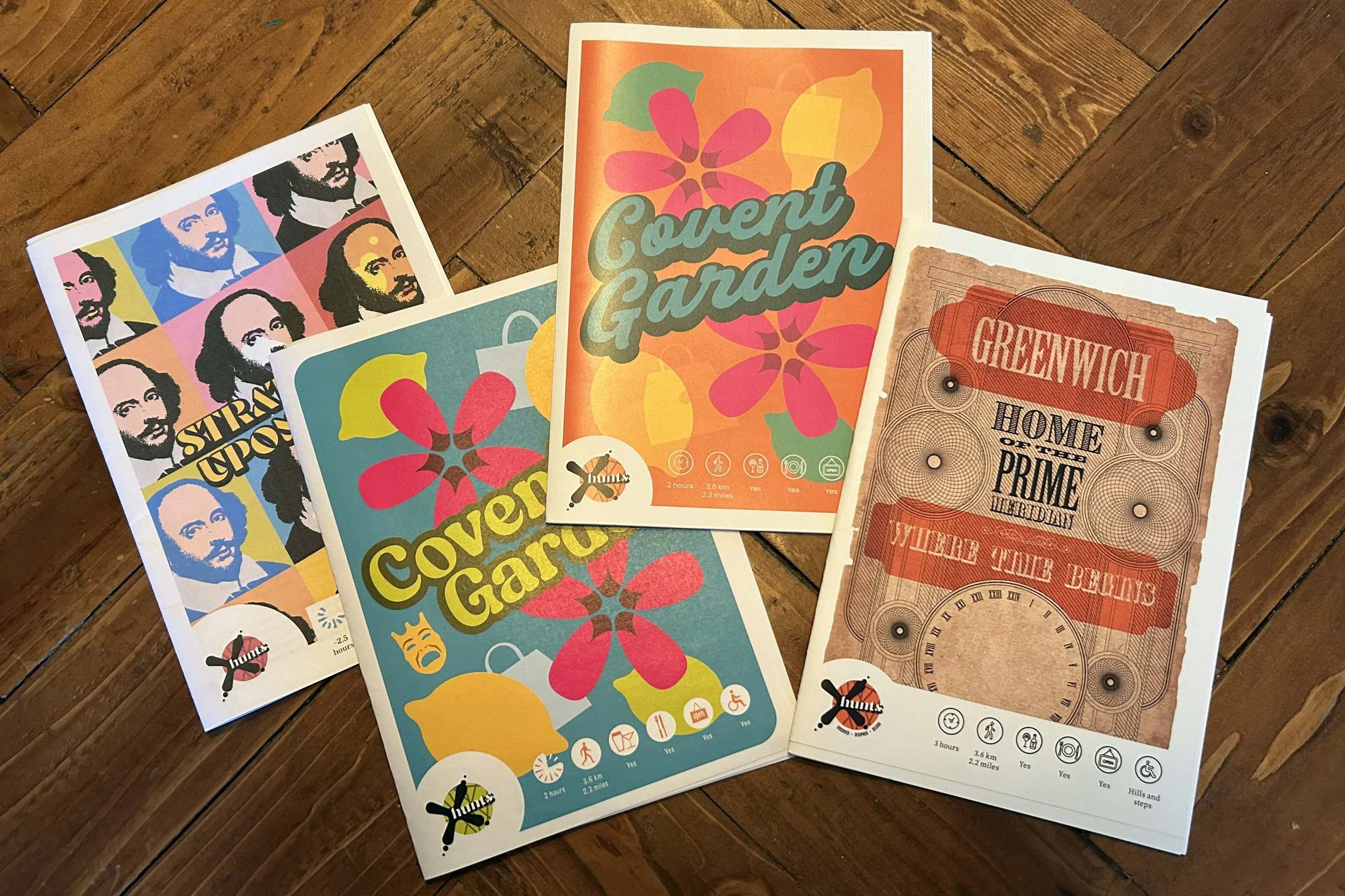
Some early cover ideas that didn’t make it. Nothing wrong with them per se, just not conveying the right feeling for us!
Testing and editing
After design, we test! A desk test initially, then out round the route. Sometimes it’s us and sometimes we send out our trusty helpers!
Desk testing make sure everything works and real world testing makes sure the map is correct and the pacing is good. Sometimes we cut one or two as they interrupt the flow for whatever reason.
The order matters almost as much as the content – harder clues work best in the early to middle part of the hunt, where players are enthusiastic and warmed up but not yet tired. The final few clues before the cipher should feel achievable, so the hunt ends on a high rather than a groan.
When is it done?
Is it ever? Sometimes you just have to call it and send to print! We love the printed copies arriving from the printer but I try not to look too closely - I know I’ll see something I want to change!
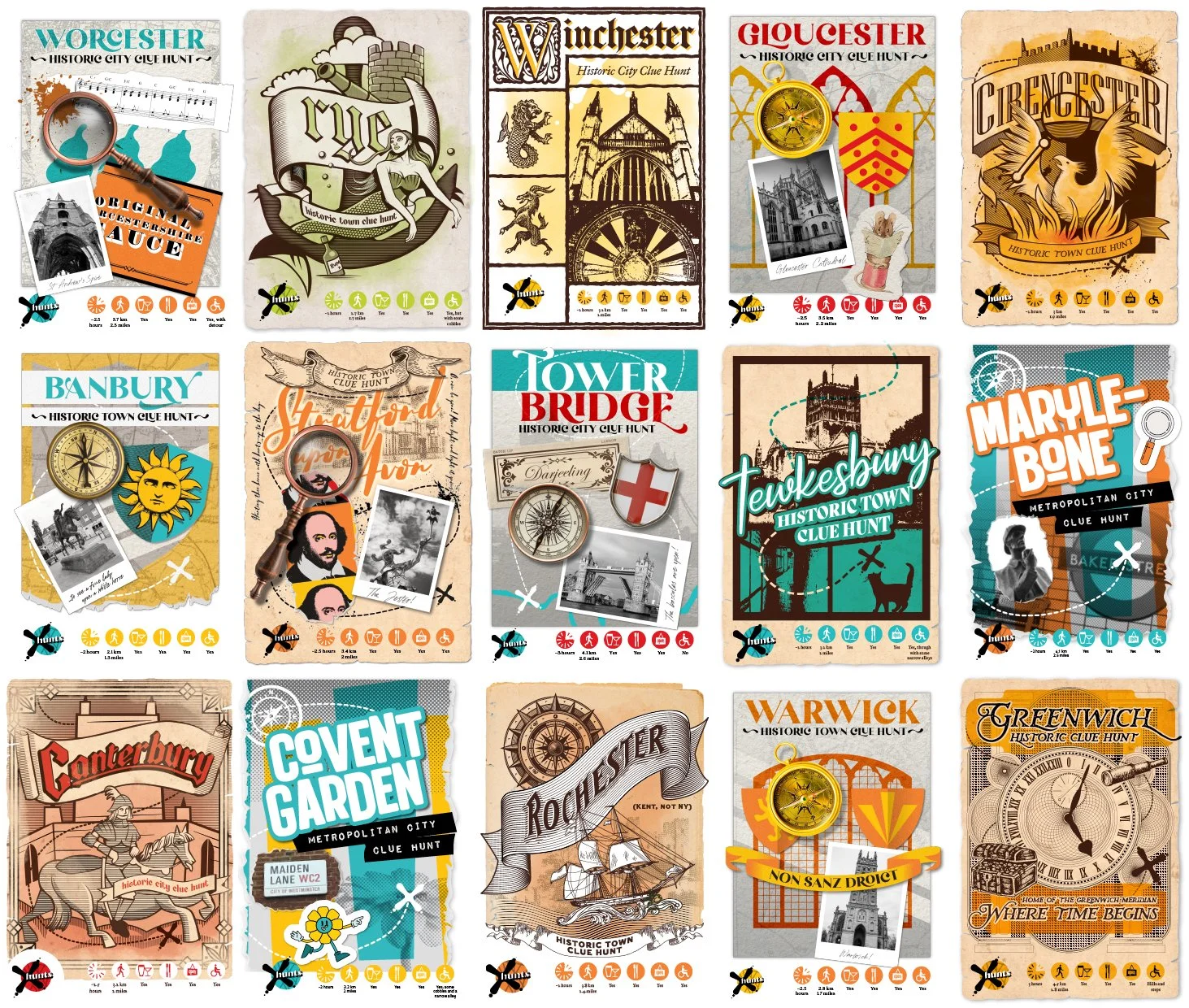
The current collection at time of publishing!